





When Ju Rhyu launched Hero Cosmetics in 2017, it launched on Amazon with just one product, which remains, nearly a decade later, its hero (no pun intended)—the Mighty Patch Original patch, for covering pimples.
K-beauty was already gaining traction in the US—consumers knew about sheet masks and BB creams—but pimple patches had yet to break into the mainstream. Rhyu set out to introduce the category to American consumers.
The bet paid off handsomely. In September 2022, Church & Dwight acquired Hero Cosmetics for $630 million.
Now, Rhyu is ready to start the entrepreneurial journey all over again, in a category far more crowded than the nascent hydrocolloid patch space was in 2017.
On September 15, Rhyu announced the launch of Vize, a sunscreen brand she co-founded with board-certified dermatologist Dr. Aimee Paik, formerly Medical Director at direct-to-consumer prescription skincare company Apostrophe. The two first met as undergraduate students at Brown University.
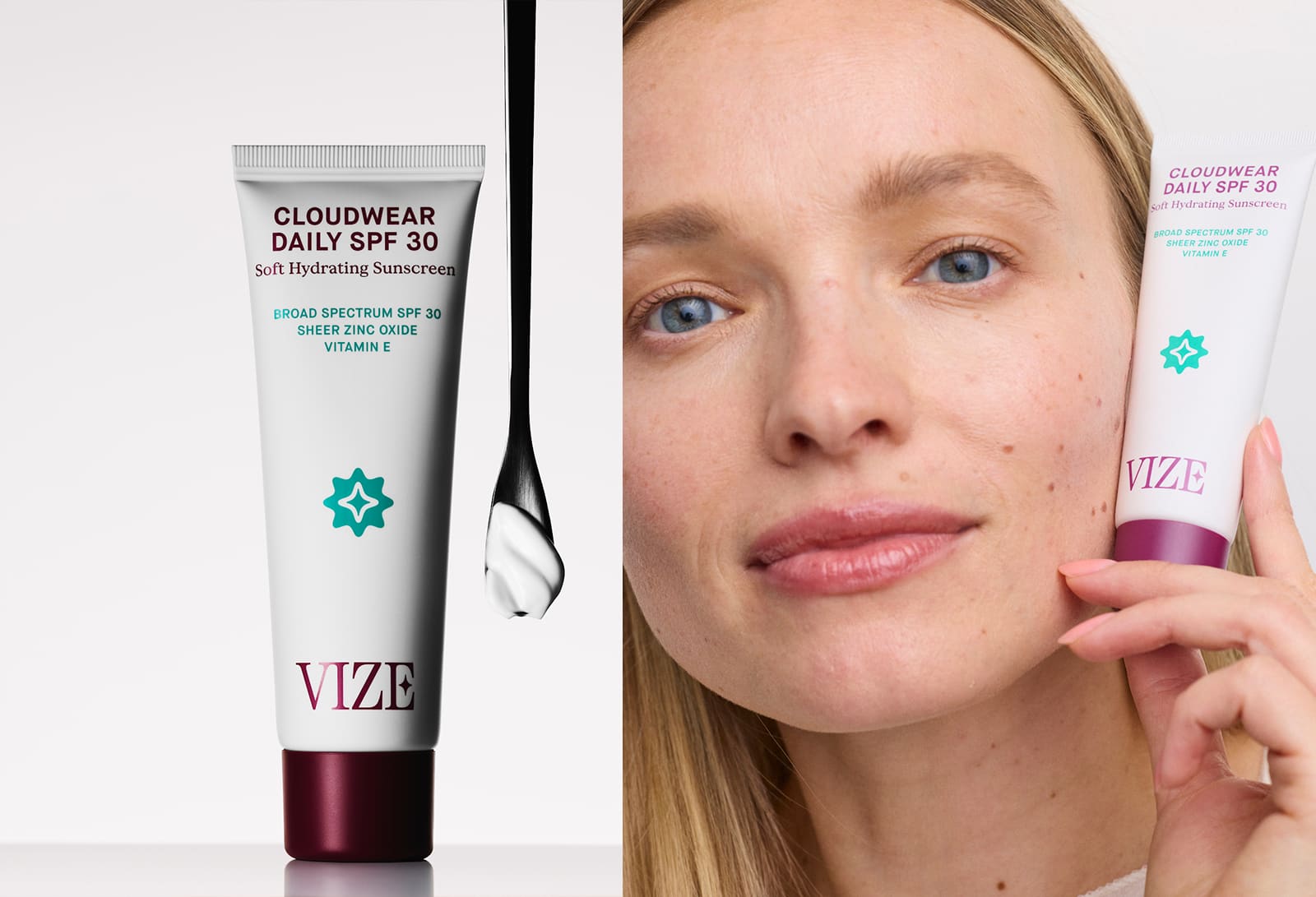
Like Hero, Vize debuts with just one SKU, a facial SPF launching DTC for $24. Dubbed Cloudwear Daily SPF 30, it was designed to work for busy women who need it to multitask as both sun protection and a morning moisturizer.
Rhyu imagines the brand will land on mass retail shelves. At Target, for example, the current facial sunscreen assortment is plentiful—it spans brands including Neutrogena, CeraVe, La Roche-Posay, Byoma, and Prequel. Still, Rhyu believes there is still room for Vize to thrive when it lands. “I think there is real white space in mass retail for Vize. I don’t think anyone has owned authority in daily facial suncare in the same way consumers think about their everyday skincare. Sunscreen really is a speciality that deserves a brand with expertise,” she told BeautyMatter.
Vize’s formula is a hybrid sunscreen, formulated with 10.15% zinc oxide and 7.5% octinoxate. The zinc oxide it uses is finely milled, coated, and suspended in a proprietary dispersion designed to promote even application and a sheer finish, while octinoxate provides complementary UV protection and supports a more refined texture. The formula also contains HydraSync Complex, the brand’s proprietary emollient blend intended to provide lasting hydration, and antioxidant vitamin E to help defend against free radicals associated with visible skin aging.
When Rhyu sold Hero, she wasn’t sure what she’d do next. But perhaps: “Once an entrepreneur, kind of always an entrepreneur,” she said, reflecting on her own journey to Vize.
Rhyu joins a growing group of beauty entrepreneurs who have returned with new ventures after exiting the brands that made them successful—with varying results. Bobbi Brown followed her namesake company with Jones Road; Wende Zomnir went from Urban Decay to Caliray; Carisa Janes followed Hourglass with Outside In, and Jerrod Blandino followed Too Faced with Polite Society. Most recently, Nancy Twine announced Soulstice after selling Briogeo, and Gregg Renfrew will soon follow Beautycounter with Beecee, focused on Gen Z. And this is not even an exhaustive list.
“You have time on your hands, you know, what else are you gonna do?” Rhyu told BeautyMatter. The second time around also comes with certain advantages. “Once you've been in beauty, the second time, you have a lot of shortcuts—you know people, you have relationships. The journey can be quicker because you know which commands to work with, or not work with, or recruiting is easier—things like that,” she said.
Although beauty has become considerably more crowded since Hero launched, Rhyu still believes there is room for new ideas and entrepreneurs. “There's always something that someone with a really great idea can execute, and I think that's the great thing about beauty—the consumer is always wanting something more, so it's fun to be able to deliver a brand that hopefully can cut through the noise.”
Still, Rhyu recognizes that, unlike with Hero, Vize is not introducing consumers to a new category. According to Mintel, the US suncare and skin-protection market was valued at nearly $2 billion in 2025 and is forecast to exceed $2 billion in 2026.
But she said differentiation can come not just from category but also from understanding exactly whom a brand serves. “My philosophy is, if you know your audience and can really create something differentiated in terms of the brand vibe, who you're targeting, the messaging, and some element of product innovation—there's always an opportunity.”
Vize is specifically targeting women in their 30s and 40s, a consumer for whom Dr. Paik believes there is white space in sunscreen. “I think this demographic hasn't been targeted from a marketing standpoint … At this age, women are really starting to notice signs of aging and want to do something about it. [They] want to be proactive about it. That's a perfect fit for a sunscreen product because sunscreen is the single most important thing you can do for how your skin ages,” Dr. Paik told BeautyMatter, noting the price difference between its first launch and popular dermatologist-recommended options like EltaMD, which runs between about $40-$50 for a facial sunscreen.
Plus, as Dr. Paik noted, this is a product you want to finish reasonably quickly. “It’s so expensive for something that you should be using generously and liberally and daily,” she said. The more affordable options from the drugstore mainstays like Neutrogena and CeraVe, Dr. Paik said, "are greasier, they're stickier, they're harder to use on a daily basis.”
Rhyu and Paik self-funded the brand, with “about $1 million dollars to get us through launch,” according to Rhyu. Rhyu self-funded Hero, too, and plans to launch Vize with a similar strategy, which she’s labeled “Crawl, Walk, Run,” “I'll say it's been really interesting doing it a second time—because the irony is you don't really need money, but people want to give you money because of your success from the first one,” Rhyu said.
“Sunscreen is notoriously a very capital-intensive category. There's a lot of testing that you have to pay for, and it takes a lot of time … I’m a big fan of the crawl, walk, run strategy. Like, let's just start with one,” Rhyu said of the brand’s one-SKU launch approach. “Let's see if we can really fine-tune and test different messaging, and nail [that] messaging and the brand positioning with the one SKU before we really start investing in #2, #3, #4,” she said, though she acknowledged that the brand does have a pipeline and is planning for a second product to launch next spring.
The launch was informed by another three-word framework too, which Rhyu refers to as T.E.D.—trust, education, and desirability. “A lot of brands [have] one or two of those three things, but not all three … Some might have the trust, or they have a nice texture, but they don't necessarily have the desirability, or they have the desirability, but they don't necessarily double down on trust—so we're trying to do all three, and that's our differentiation,” she said.
Testing sunscreen is notoriously expensive. “We spent about $50K on our testing last year, which included the two SPF tests, stability, micro, assay, and consumer perception tests,” Rhyu said. BeautyMatter’s editorial team reviewed and confirmed the validity of Vize’s in vivo lab SPF results.
In the US, of course, sunscreens are regulated as over-the-counter drugs. Finished formulas must undergo Food and Drug Administration (FDA)-prescribed SPF testing, while broad-spectrum and water-resistance testing are required to substantiate those respective claims. Manufacturers must also comply with requirements governing permitted active ingredients, stability, batch quality, drug listing, labeling, and current Good Manufacturing Practices. Vize says Cloudwear Daily provides Broad Spectrum SPF 30 and PA+++ protection. The PA system, commonly used in Asian markets, indicates a product’s level of protection against UVA rays, which contribute to skin aging and pigmentation. It is separate from the FDA’s broad-spectrum designation.
While independent testing is not federally mandated, Vize elected to have its formula tested by two separate laboratories.
“Our philosophy is to always test each sunscreen at least two times from two different independent labs. So for our first formula, the first result we got was an SPF 46, and the second second lab result was an SPF 30. So we feel very very confident that [the product] is a true SPF 30, and that we can really say, if it's tested by a million consumer watchdog groups, that it will perform at SPF 30,” Dr. Paik said.
Vize hopes to establish trust by working with a range of creators to educate around SPF via social media. "As we launch, our seeding and creator strategy is focused across three groups: experts, including dermatologists, cosmetic chemists, and product developers who understand how challenging it is to formulate an SPF that delivers both protection and a great consumer experience; beauty authorities, [such as] creators and editors who test a high volume of product and can speak credibly to real-world performance—how SPF wears under makeup, layers with skincare, and fits into an everyday routine; and everyday SPF consumers—people who haven't found a sunscreen they love enough to use consistently, or who aren't yet applying SPF every day,” Rhyu said.
Dr. Paik herself won’t be the primary face of the brand—and neither will Rhyu. But Rhyu believes that Dr. Paik’s co-founding of the brand and input in its formulation will lend it credibility as it establishes partnerships with other creators, whose faces will appear in branded content. “I don't think brands necessarily always need someone front-facing, and I think the fact that Aimee is a derm lends a lot of credibility to other derms, consumers, and creators,” Rhyu said.
“We want Vize to provide both the education and the product experience that makes daily application feel intuitive. We're still in early conversations around paid partnerships, but we're being intentional about identifying partners across these three groups rather than relying on one type of creator or a traditional ‘DermTok’ strategy."
Sunscreen sales traditionally peak between May and August, but Rhyu and Paik intentionally waited until after summer to introduce Vize. The timing supports the brand’s central message: Sunscreen should be a year-round component of a skincare routine.
Vize’s burgundy-and-green color palette was similarly selected to avoid looking overtly summery. “In terms of our styling, our models have clothing on. They're wearing hats. Those are all really important things … There's a big misconception that sun damage only happens when you get sunburned, which is not true. Actually, the majority of aging is from UVA rays, which do not cause burning,” Dr. Paik explained.
The brand’s influencer mailer includes a neck scarf, reinforcing both the seasonal positioning and its sun-protection message. “It’s perfect for fall or winter—it’s [another way] to protect the neck and decolletage area,” Rhyu said.
Vize plans to lean into “Not Just for Summer” as a tagline, supported by the brand’s imagery and gifting strategy. Launching after sunscreen’s traditional peak season will put that proposition to an immediate test—and show whether Rhyu can apply the single-product playbook behind Hero to a category in which consumers already have no shortage of choices.